If you got hit by a bus tomorrow, would your business survive the week?
Not gracefully. Not well. Just survive. Would payroll go out on Friday? Would someone know which clients to call? Would the crew show up Monday morning and know what to do — or would they stand around waiting for instructions that aren’t coming?
Most owners don’t know the answer. Every serious buyer does — because they’ve already figured it out before they make an offer. And if the answer is “it wouldn’t survive,” the offer either doesn’t come or it comes at a steep discount.
This isn’t a hypothetical exercise. It’s the single most revealing test of how your business actually works — and it takes about five minutes of honest thinking to run it.
What Actually Happens in Week One — the Three Things That Break First
Same order. Every time.
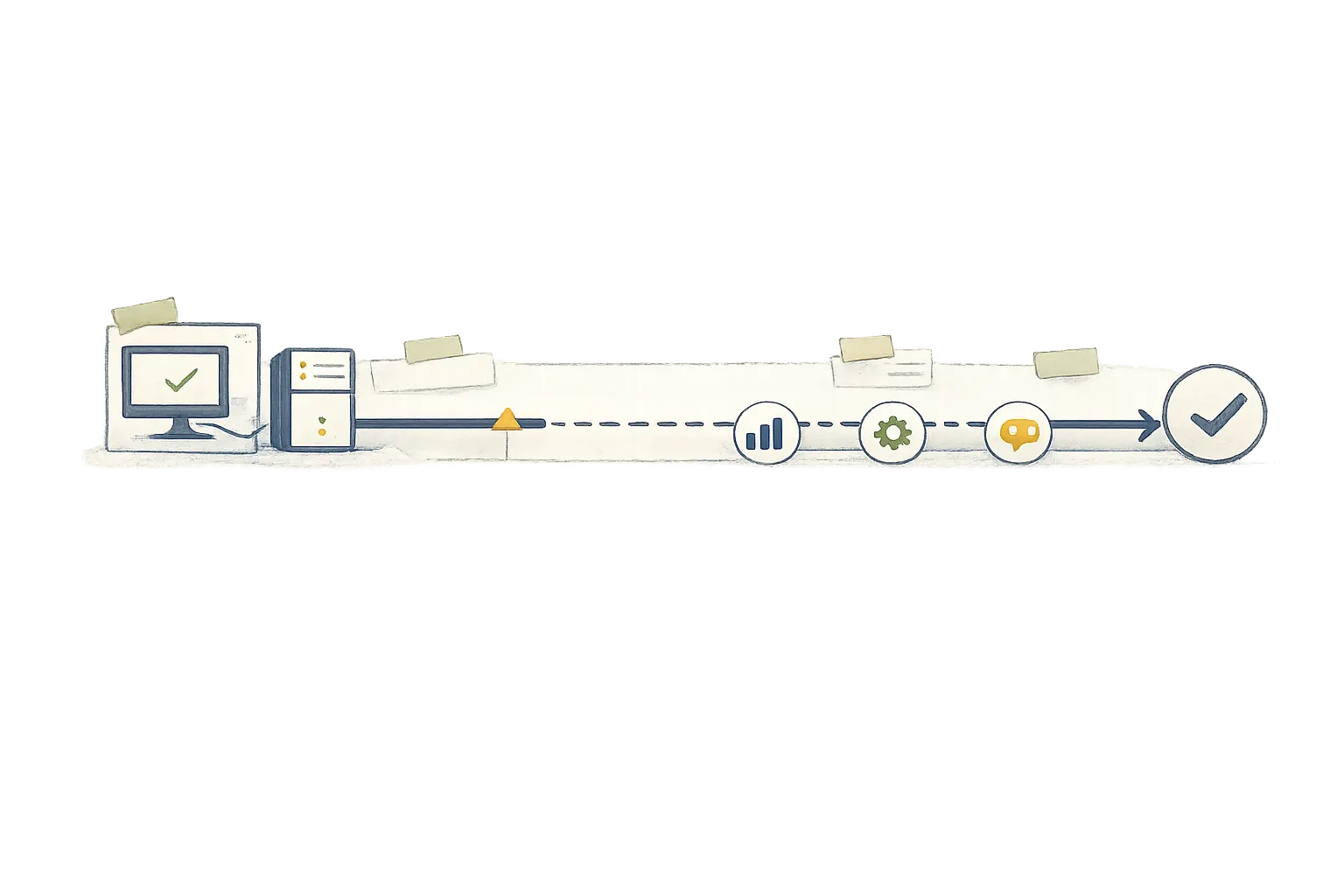
When an owner is suddenly unavailable — a health emergency, a family crisis, or something worse — the same three things break in almost every owner-dependent business. Same order. Every time.
Cash flow stops moving. Somebody has to sign checks, approve invoices, and make sure payroll runs. In many businesses this size, the owner is the only person with access to the accounts, the only signer on the line of credit, and the only person who knows which bills are due when. A legal analysis by the law firm Schwabe noted that just a few weeks of missed payroll, vendor payments, and billing can create enough disruption for a business to fail — even if the owner eventually recovers.
Client relationships go dark. Your biggest clients are used to hearing from you. When you go silent, they don’t call your office manager — they call their backup option. In service businesses, this can mean lost contracts within days. In construction, it can mean a GC pulling you from a bid list because nobody answered the phone with any authority. The relationships you’ve spent fifteen years building can start to erode in one week of silence.
Decisions stop. Every significant decision runs through one person. Pricing a job. Handling a client complaint. Approving a purchase order. Managing a personnel issue. When that person is gone, the team doesn’t make bad decisions — they make no decisions. Work slows. Problems pile up. And the longer you’re out, the harder it is to dig out when you return.
The team doesn’t make bad decisions — they make no decisions.
None of this is because your team is incompetent. It’s because the business was built to run through you, and nobody set it up to run without you. That’s not their failure. It’s a structural problem — and it’s fixable.
What This Tells a Buyer About What Your Business Is Worth
Every one of those failure points is something a buyer evaluates. They don’t call it “the bus test” — they call it key person risk. But they’re asking the same question: what happens to this business if the owner isn’t here?
If the answer is “things break badly,” the buyer sees a fragile business. Fragile businesses get discounted. The common M&A heuristic prices owner dependence at 1 to 2 full EBITDA turns below comparable businesses with operational independence. On a million dollars of EBITDA, that’s a $1 to $2 million haircut — before the negotiation even starts.
The bus test isn’t just a thought experiment. It’s the foundation of real business exit planning. A business that fails this test isn’t just at risk of an emergency — it’s actively worth less, every single day, than it would be if it could run without you.
The full math on what this dependency costs is in Owner Dependence Is Costing You More Than You Think.
What Happens to a Small Business If the Owner Becomes Incapacitated?
When a small business owner becomes suddenly incapacitated, three operational functions typically fail within the first week: financial operations (payroll, accounts payable, banking access), client-facing communication (key relationships go unanswered), and decision-making authority (no one has the standing or knowledge to approve work, resolve disputes, or commit resources). Without a designated successor, power of attorney, or documented processes, the business may require court intervention to appoint someone to manage operations — a process that takes weeks or months. In the most severe cases, a business loses enough revenue and operational momentum during this period that it cannot recover, even after the owner returns. The starkest evidence comes from a natural experiment: a study in the Review of Finance tracked nearly 1,500 firms whose founders died and found large, sustained declines in growth and profitability — a mean effect on sales of about 60 percent for larger startups, with many smaller firms shutting down entirely (Becker and Hvide, 2022). The risk is highest in businesses where the owner is the sole signer on financial accounts, the primary holder of client relationships, and the only person with authority to make operational decisions.
What a Business That Passes the Bus Test Looks Like
It doesn’t look dramatically different from the outside. You’re still leading it. The difference is structural:
Someone besides you can sign checks, run payroll, and manage cash flow — because they’ve been doing it alongside you for months, not scrambling to figure it out in a crisis.
Your top ten clients have a relationship with at least one other person at your company — someone who’s attended meetings, handled issues, and earned their own trust.
Your team knows what to do for the next two weeks without asking you. Not forever. Just long enough to keep the business moving while things get sorted.
Critical processes — how you estimate jobs, onboard clients, handle quality issues — exist somewhere other than your head. A shared drive, a set of SOPs, even a notebook. Not perfect. Just documented enough that someone could follow them.
That’s it. Not a transformation. Just enough structure that the business keeps breathing if you can’t be in the room.
Where to Start This Week
Run the test. Not someday — this week. Answer three questions honestly:
If I were gone for 30 days, who would handle the money? If the answer is “no one” or “my spouse would figure it out,” that’s your first fix.
If I were gone for 30 days, what would happen to my three biggest client relationships? If the answer is “they’d wait for me” — or worse, “they’d find someone else” — that’s your second fix.
If I were gone for 30 days, who would make the decisions that keep the business running? If the answer is “nobody” — that’s your third fix.
You don’t need to solve all of this today. But you need to see it clearly. Because the bus test doesn’t just reveal what would break in an emergency — it reveals what’s already limiting your business, your value, and the security of the people who depend on you.
If your team is what keeps you up at night — if the thought of something happening and your people being left without a plan is what really bothers you — read The Exit Plan Your Employees Wish You Had. Having a plan isn’t abandoning them. It’s the most protective thing you can do.
That’s what it means to plan the exit.
Find out how dependent your business is on you — take the 2-minute Exit Readiness Assessment.
It’s free. The results are immediate. And they’re yours — not a sales pitch.
Want to talk through what you found? Book a free 30-minute Debrief Session. No pitch. No pressure.
Read next: Owner Dependence Is Costing You More Than You Think