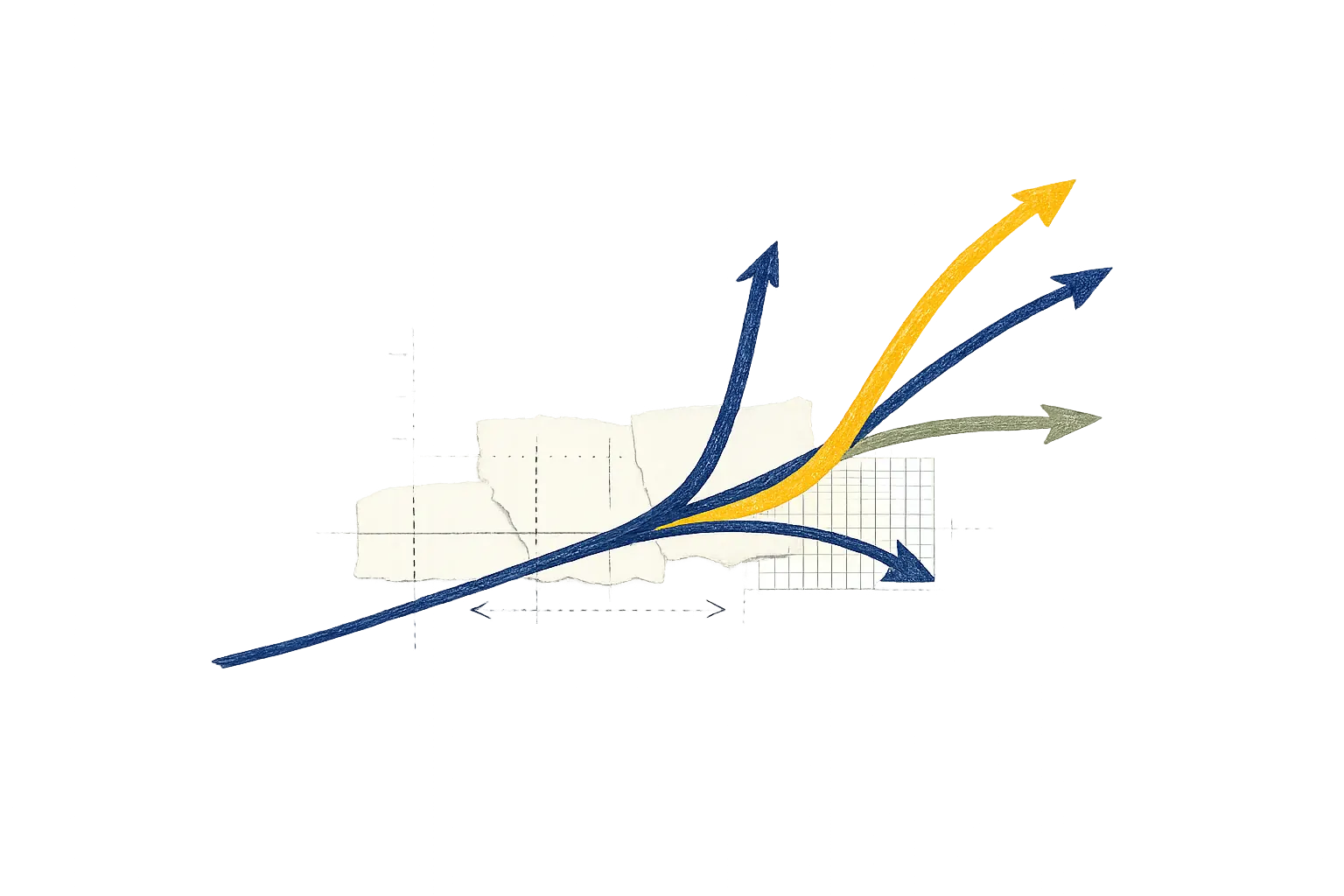
An owner-dependent business sells for less. Not a little less. The difference between a business that runs without you and one that doesn’t can be one to two full turns of EBITDA. On a business earning $1M in EBITDA, that’s $1 to $2 million less in your exit check — same revenue, same profit, same team. Just a different answer to the question: “Can this business function without the person who built it?”
That discount is real. And it’s probably costing you more than you’ve calculated — not just at the exit, but every year you keep running this way.
What the Multiple Difference Actually Looks Like in Your Industry
The valuation discount for owner dependence isn’t theoretical. It shows up in transaction data across the industries where we work.
Construction and specialty trades. Private construction businesses typically trade between 3x and 5x EBITDA. But within that range, the spread between owner-dependent and owner-independent businesses is dramatic. A specialty contractor with documented processes, a management team making daily decisions, and client relationships held by the company — not the founder — will land at the higher end. A contractor where the owner estimates every job, manages every major client, and approves every purchase order will land at the low end, if they can find a buyer at all. The common M&A heuristic — a practitioner rule of thumb, not a published statistic — prices heavy owner dependence at 1 to 2 turns of EBITDA below comparable independent businesses.
Manufacturing. Manufacturing businesses in the private market generally see multiples of 3.5x to 6x EBITDA, with the range driven by proprietary products, customer diversification, and management depth. The owner who personally quotes every job, manages the top ten accounts, and holds all the technical knowledge in their head will see their multiple compressed to the bottom of that range — and in the severe cases, buyers pass on the business entirely until the dependence is restructured.
Professional services. Staffing, IT services, and engineering firms trade between 4x and 7x EBITDA. Recurring revenue and client retention drive the high end. But when client relationships are tied to the founder — when the biggest accounts are really relationships with one person — the multiple drops, and deal structures shift heavily toward earnouts that keep the owner locked in for years.
Same business. $2M apart.
Here’s what that looks like in dollars. A construction company doing $8M in revenue with $1M in EBITDA and strong owner dependence might get 3x — a $3M exit. The same business with documented processes and a real management team might get 5x — a $5M exit. That’s a $2M difference. Same revenue. Same profit. Different answer to one question.
It’s Not Just the Exit — What Owner Dependence Costs You Every Year
Most owners think about owner dependence as an exit problem. It’s not. It’s a daily operating cost that compounds every year you don’t address it.
Your time. If you’re working 55 hours a week because every major decision, every key client interaction, and every critical process runs through you, that’s not dedication — it’s a structural problem. It’s also the norm: Gallup’s tracking found the self-employed work more hours than any other class of American worker, with 26 percent logging more than 60 hours a week (2009). Those are hours you’re not spending on strategy, growth, or the parts of the business that actually need your attention. And they’re hours you’re not spending with your family, your health, or anything outside the business.
Growth ceiling. Owner-dependent businesses hit a natural revenue plateau. There’s a limit to how much one person can sell, manage, and deliver. Many businesses stall between $5M and $10M specifically because the owner is the bottleneck — not the market, not the team, not the product. Every year you stay at that plateau is a year of revenue you didn’t capture because you couldn’t delegate the work that got you there.
Risk exposure. If you’re the single point of failure, one health scare, one family emergency, one bad month changes everything. Not just for you — for your entire team. The business that can’t function without you is a business that puts thirty or forty families at risk every time you get on a plane or skip a checkup.
Burnout. This is the one nobody wants to talk about. You’re tired. You’ve been tired for years. The reason you haven’t taken a real vacation isn’t that you don’t want to — it’s that you can’t. The business won’t let you. That’s not a badge of honor. It’s a symptom of a structural problem that’s solvable.
That’s not a badge of honor. It’s a symptom of a structural problem that’s solvable.
The cost of owner dependence isn’t just what shows up in a lower multiple at exit. It’s the compounding toll on your time, your health, your growth, and the security of the people who depend on you.
How Does Owner Dependence Affect Business Valuation?
Owner dependence reduces business valuation because buyers apply a “key person discount” — the industry still often calls it a “key man discount” — to account for the risk that the business will decline after the owner exits. The common M&A heuristic prices high owner dependence in sales, operations, or institutional knowledge at 1 to 2 fewer turns of EBITDA than comparable businesses with strong management teams and documented processes. For a business with $1M in EBITDA, this means a valuation reduction of $1M to $2M. In severe cases — where the owner is the sole client relationship holder, the only person who can estimate jobs, or the single source of institutional knowledge — many buyers will not proceed with the acquisition at all, or will restructure the deal around earnouts and multi-year transitions. The discount is compounded when lenders also perceive the risk: banks financing acquisitions often reduce loan amounts for owner-dependent businesses, further limiting the buyer pool and suppressing the final sale price. The buyer pool itself shifts, too. In the IBBA and M&A Source Market Pulse survey covering 2025, first-time buyers and serial entrepreneurs together made 78 percent of Main Street acquisitions under $2M — when a business can’t run without its owner, the market for it is dominated by people shopping for the owner’s seat, not investors paying for an enterprise.
The Math on What Fixing This Is Worth
The math is simple. If reducing owner dependence moves your multiple from 3.5x to 5x on $1M of EBITDA, that’s $1.5M in additional exit value. If it moves you from 4x to 6x, that’s $2M. And those numbers only account for the exit.
Factor in the annual benefits — more time, less stress, faster growth, reduced risk — and the return on investing in owner independence is one of the highest-yield decisions you can make as a business owner. It’s not a cost. It’s an investment that pays you back every year you own the business and again when you sell it.
The owners who see the biggest gains are the ones who treat this as business exit planning that starts years before the exit — not weeks before a meeting with a buyer.
Where to Start
You don’t need to overhaul your entire business overnight. Start by figuring out where the dependence actually lives. Is it in sales? Operations? Institutional knowledge? Usually it’s all three, but one is worse than the others.
That’s exactly what the Exit Readiness Assessment is designed to show you — and it’s the first step toward protecting both your value and the team you’ve built. If you want the full picture of what owner independence looks like in practice, start with How to Build a Business That Runs Without You. And if the loyalty angle resonates — protecting your people, not just your number — read The Exit Plan Your Employees Wish You Had.
Find out how dependent your business is on you — take the 2-minute Exit Readiness Assessment.
It’s free. The results are immediate. And they’re yours — not a sales pitch.
Want to talk through what you found? Book a free 30-minute Debrief Session. No pitch. No pressure.
Read next: If You Got Hit by a Bus Tomorrow, Would Your Business Survive the Week?